
Game Information
Blackjack
Read our Blackjack guide at Captain Free Spins. Learn RTP, rules, strategy and gameplay tips for UK online casino players.
Blackjack Guide – How to Play, Strategies & House Edge
Blackjack is one of the most popular casino card games in the world, and it has remained a favourite for decades thanks to its mix of luck, strategy, and relatively low house edge.
Unlike most casino games, blackjack allows players to influence the outcome through their decisions. While the cards you receive are random, the choices you make during each round can significantly affect your chances of winning.
The goal of the game is simple: beat the dealer by getting a hand total closer to 21 without going over. If your hand exceeds 21, you bust and lose the round automatically.
There are several variations of blackjack played around the world. In the United Kingdom, the most common version is European blackjack, which uses slightly different rules from the American version often played in Las Vegas.
What Is Blackjack?
Blackjack is played between the dealer and one or more players. Each player competes only against the dealer, not against other players at the table.
At the start of each round, both the player and the dealer receive cards. Your aim is to build a hand value that beats the dealer’s hand without going over 21.
A two-card combination of an Ace and any 10-value card is called a natural blackjack. This is the strongest starting hand and usually pays 3:2.
Understanding how card values work is essential when learning blackjack.
| Card Type | Value | Notes |
|---|---|---|
| Number cards (2–9) | Face value | A 7 counts as seven, a 9 counts as nine. |
| 10, Jack, Queen, King | 10 points | All face cards are worth ten. |
| Ace | 1 or 11 | The value adjusts depending on what benefits the hand. |
How to Play Blackjack
Blackjack is played using standard 52-card decks. European blackjack usually uses two decks, while American blackjack often uses six or eight.
A typical round of blackjack follows a simple sequence of steps.
1 – Players place their wagers before any cards are dealt.
2 – Each player receives two cards, and the dealer shows one card face up.
3 – Players decide how to play their hand by hitting, standing, doubling down or splitting.
4 – In European blackjack the dealer only draws their second card after all players have acted.
5 – The dealer must continue drawing cards until reaching at least 17.
6 – The dealer’s hand is compared with each player’s hand and winning bets are paid.
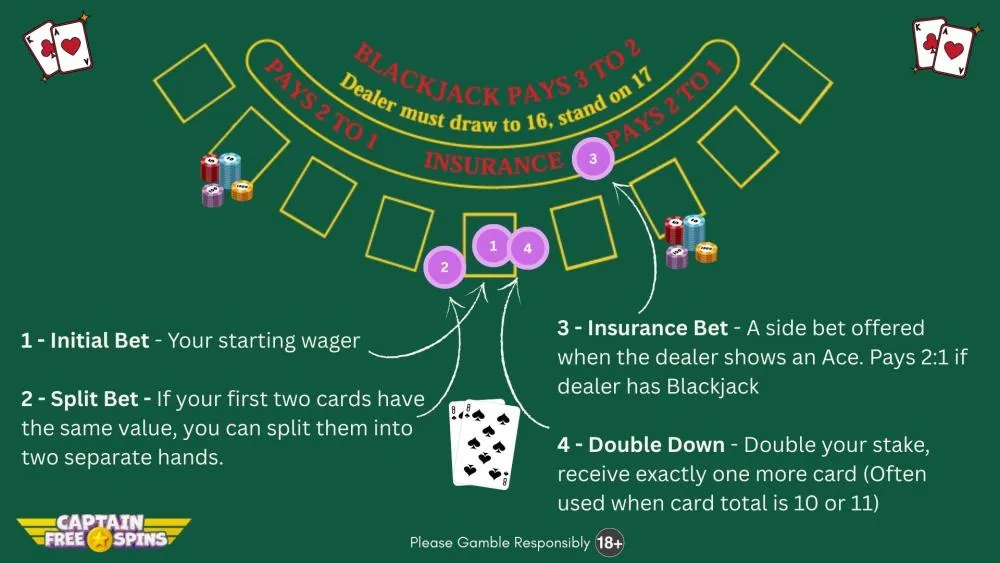
Player Actions & Betting Options
Once you receive your first two cards, you have several choices depending on your hand and the dealer’s up card.
| Card Type | Value | Notes |
|---|---|---|
| Number cards (2–9) | Face value | A 7 counts as seven, a 9 counts as nine. |
| 10, Jack, Queen, King | 10 points | All face cards are worth ten. |
| Ace | 1 or 11 | The value adjusts depending on what benefits the hand. |
European vs American Blackjack
Although the rules are similar, there are several important differences between European and American blackjack.
| Action | Description | Typical Use |
|---|---|---|
| Hit | Take another card. | Used when your total is low and you want to improve it. |
| Stand | Keep your current hand. | Used when hitting could cause you to bust. |
| Double Down | Double your wager and receive one card. | Often used when holding totals of 9–11. |
| Split | Divide a pair into two hands. | Common with pairs such as A-A or 8-8. |
| Insurance | Side bet offered when the dealer shows an Ace. | Usually not recommended due to its higher house edge. |
Payouts & Odds
Blackjack payouts depend on how your hand compares to the dealer’s.
| Outcome | Payout | Example |
|---|---|---|
| Natural Blackjack | 3:2 | £10 bet wins £15 |
| Standard Win | 1:1 | £10 bet wins £10 |
| Push (Tie) | Bet returned | No win or loss |
| Insurance | 2:1 | Wins only if dealer has blackjack |
Basic Blackjack Strategy
One of the reasons blackjack remains so popular is that players can improve their chances by following basic strategy. This is a mathematically calculated approach that shows the best decision for every possible hand.
Using basic strategy can reduce the house edge to around 0.5% in many blackjack games.
Some key principles include:
• Always split Aces and 8s.
• Never split 5s or 10s.
• Double down when holding strong totals like 10 or 11.
• Stand on hard totals of 17 or more.
Tips for Playing Responsibly
Blackjack can be exciting and fast-paced, but it is important to play responsibly.
• Choose games with favourable rules such as 3:2 blackjack payouts.
• Set a budget before you start playing and stick to it.
• Avoid chasing losses and treat blackjack as entertainment rather than a way to make money.
• Practise with free blackjack games before playing with real money.
Understanding the Blackjack House Edge
One of the main reasons blackjack remains so popular is its relatively low house edge compared with most other casino games. When played with correct basic strategy, blackjack offers one of the best theoretical returns available in a casino.
The house edge represents the casino’s mathematical advantage over the player. In simple terms, it is the percentage of every bet the casino expects to keep over the long run.
For example, if a blackjack table has a house edge of 0.5%, the casino expects to retain around £5 for every £1,000 wagered over time. This does not mean you will lose money every session, but it explains why casinos remain profitable over many games.
The exact house edge depends heavily on the rules of the blackjack game you are playing. Small rule changes can significantly alter the advantage between the casino and the player.
| Rule Change | Impact on House Edge |
|---|---|
| Blackjack pays 3:2 | Standard rule with lower house edge |
| Blackjack pays 6:5 | Increases house edge by around 1.39% |
| Dealer stands on soft 17 | Reduces house edge by around 0.22% |
| Double after split allowed | Reduces house edge slightly |
| More decks used | Increases house edge slightly |
When choosing a blackjack table, it is always worth checking the rules. Tables with fewer decks, 3:2 blackjack payouts, and flexible player options will generally offer better long-term value.
Blackjack Odds & Probabilities
Understanding the probabilities in blackjack can help players appreciate why certain strategy decisions are recommended. While the cards are dealt randomly, the mathematics behind the game remains consistent over time.
For example, the probability of being dealt a natural blackjack from a standard multi-deck shoe is roughly 4.8%. This means that on average, a player will receive a blackjack about once every 21 hands.
| Event | Approximate Probability |
|---|---|
| Player receives natural blackjack | 4.8% |
| Dealer receives blackjack | Around 4.7% |
| Player busts when hitting on 16 | Approximately 62% |
| Player busts when hitting on 15 | Approximately 58% |
| Dealer bust probability | Around 28% |
These probabilities help explain why strategy charts recommend standing on certain totals and hitting on others. Over thousands of hands, these decisions statistically produce the best possible outcome for the player.
Common Blackjack Mistakes
Many blackjack players lose more money than necessary because they ignore basic strategy or rely on instinct instead of mathematics. While the game feels simple, small mistakes repeated over many hands can significantly increase losses.
One of the most common mistakes is taking insurance whenever the dealer shows an Ace. Although the bet can feel tempting, it is statistically unfavourable in most situations.
Another mistake is splitting tens. A pair of tens forms a total of 20, which is already one of the strongest hands possible. Splitting them weakens a very strong position.
Players also sometimes double down in situations where the odds are poor, such as doubling against a dealer Ace or ten. Basic strategy charts exist specifically to prevent these mistakes.
Finally, many beginners chase losses by increasing their bet sizes. Blackjack outcomes are unpredictable in the short term, so changing your betting pattern does not improve your chances of winning.
Online Blackjack vs Live Dealer Blackjack
Online casinos now offer two main ways to play blackjack: standard digital blackjack and live dealer blackjack. Both versions follow the same rules but offer different experiences.
Standard online blackjack uses a random number generator (RNG) to shuffle and deal cards digitally. This version is fast and convenient, allowing players to complete many rounds in a short period of time.
Live dealer blackjack is streamed from a professional studio with a real dealer and physical cards. Players place bets through an online interface while watching the game unfold in real time.
Many players prefer live blackjack because it replicates the atmosphere of a real casino. However, the pace of play is slower than RNG blackjack because the dealer must physically deal and shuffle cards.
Both versions are widely available at UK online casinos, and the choice largely depends on whether you prefer speed or realism.
Blackjack FAQs
Is blackjack a game of luck or skill?
Blackjack is a mix of both. The cards you receive are random, which introduces luck, but the decisions you make have a real impact on your chances of winning. By following basic blackjack strategy, players can reduce the house edge significantly compared with simply guessing.
What is the house edge in blackjack?
The house edge in blackjack depends on the rules of the table and how well the player follows basic strategy. In most European blackjack games, the house edge is typically between 0.4% and 0.7% when optimal decisions are made.
What is the difference between European and American blackjack?
European blackjack normally uses two decks and does not give the dealer a hole card at the start of the round. American blackjack usually uses six or more decks and deals the dealer a face-down card immediately. American games also tend to allow more flexible options such as surrender and doubling on any two cards.
Should I take insurance in blackjack?
In most situations, insurance is not recommended. Although it pays 2:1 if the dealer has blackjack, the bet has a higher house edge than the main game and generally loses money over time.
Is card counting illegal?
Card counting itself is not illegal. However, casinos are private businesses and can refuse service to players they believe are using card counting techniques. In online blackjack, card counting is also ineffective because most games use continuous shuffling systems.
Blackjack is a game of chance, with the average house edge in European Blackjack sitting around 0.50%. If you do choose to play, always set limits, play within your means, and treat roulette as entertainment, not a source of income. For support on responsible gambling, click here .