
Game Information
Roulette
Read our Roulette guide at Captain Free Spins. Learn RTP, rules, betting options and gameplay tips for UK online casino players.
About Roulette
Roulette is a popular casino table game where players bet on where a ball will land within a spinning wheel. Once bets are placed, the dealer spins the wheel and releases the ball in the opposite direction. When the ball settles into a numbered pocket, winning bets are paid according to the type of wager placed.
On a European wheel, there are 37 numbered pockets, 0 to 36 in three colours: red, black and green. Players can bet on a single number, groups of numbers, or even-money outcomes such as red or black, odd or even, and high (19-36) or low (1-18).
There are three main types of roulette: European, American and French. European roulette features 37 numbers, while American roulette includes an additional double zero (00), bringing the total amount of numbers to 38. French roulette uses the same 37 number wheel as European but includes two additional rules that slightly reduce the house edge. We explain these differences in more detail further on.
The numbers on the wheel follow a fixed layout, with red and black pockets arranged in alternating sequence and high and low numbers distributed evenly around the wheel. This design helps ensure balanced gameplay.
The average Return to Player (RTP) in European roulette is 97.30%, meaning the house edge is 2.70%. This edge comes from the single green 0, which prevents even-money bets such as red or black from being true 50/50 wagers. Importantly, all standard bets on a European wheel carry the same house edge, the difference lies in how often they win and how much they pay out.
Roulette Betting Guide
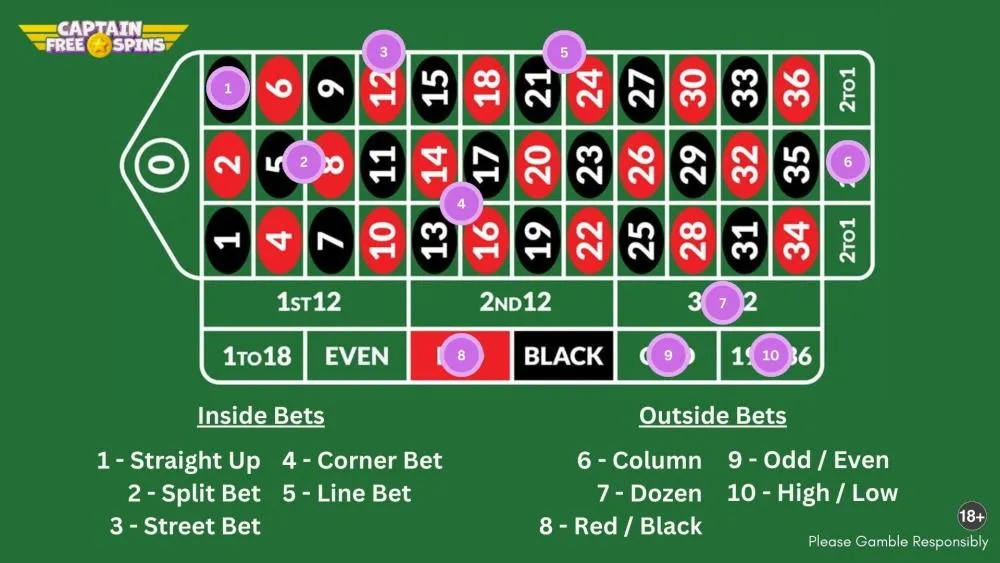
Roulette bets are divided into two main categories, inside bets and outside bets. Inside bets cover specific, individual numbers or groups of numbers. These offer higher payouts, but a lower win probability. Outside bets cover large areas on the table, including red/black bets, high/low bets and more. These offer lower payouts, but win more frequently.
Although payouts are different between all bets, a standard European roulette wheel will carry the same 2.70% house edge for all bets. The main difference is in the risk and volatility. Higher paying bets win less often, while even-money bets win more frequently, but smaller returns. Below is a guide explaining common types of both inside and outside bets.
Inside Bets
| Guide | Chips Cover | Term | Pays |
|---|---|---|---|
| 1 | 1 Number | Straight Up | 35 to 1 |
| 2 | 2 Numbers | Split Bet | 17 to 1 |
| 3 | 3 Numbers | Street Bet | 11 to 1 |
| 4 | 4 Numbers | Corner Bet | 8 to 1 |
| 5 | 6 Numbers | Line Bet | 5 to 1 |
Outside Bets
| Guide | Chips Cover | Term | Pays |
|---|---|---|---|
| 6 | 12 Numbers | Column | 2 to 1 |
| 7 | 12 Numbers | Dozen | 2 to 1 |
| 8 | 18 Numbers | Red / Black | 1 to 1 |
| 9 | 18 Numbers | Odd / Even | 1 to 1 |
| 10 | 18 Numbers | High / Low | 1 to 1 |
Types of Bets
It is important to understand how roulette bets work, to help you choose the right level of risk you're willing to take. While every standard bet carries the same 2.70% house edge, the number of pockets you cover will determine how often a bet wins or how much they pay out.
- Fewer numbers covered – lower chance of winning, but higher payout.
- More numbers covered – higher chance of winning, but lower payout.
Below, we break down each bet type with payout examples and win probabilities.
1 – Straight Up Bet
A straight up bet is where the player places their chips onto a single number. If the exact number wins, the bet wins. This comes with a payout of 35 to 1, meaning you will win 35 times your stake in profit, as well as your original bet being returned. For example, a £1 bet returns £36 in total. £35 profit plus your £1 stake back. On a standard European roulette wheel, the probability of winning is 2.70%.
2 – Split Bet
A split bet is when you place your chip on the line between two adjacent numbers on the grid, covering both. If either number hits, your bet wins. This covers 2 numbers, compared to just one in a straight up bet, increasing your odds of winning, while still offering a good payout of 17 to 1. A £1 bet wins £17, plus initial stake returned, giving you a total winnings of £18. The probability of winning on a European wheel with a split bet increases to 5.41%.
3 – Street Bet
If you place your chip on the outside edge of a row of 3 consecutive numbers, this is a street bet. It covers all 3 numbers in the row. If any 3 of those numbers hit, you will win with a payout of 11 to 1. A £1 bet wins £11 plus initial stake is returned. This gives a total winnings of £12. The probability of winning with a street bet increases slightly compared to split, up to 8.11%.
4 – Corner Bet
Place your chip at the cross point of 4 numbers that meet in a square. In the image, we use 13, 14, 16 and 17 as an example. This has a payout of 8 to 1, meaning a £1 bet wins an £8 profit, with the initial bet being returned. This gives total winnings of £9. The probability of winning with a corner bet continues to increase, moving up to 10.81%.
5 – Line Bet
A line bet, also known as a double street bet, is when you place your chip at the end of a row, between 2 rows. This then covers 6 numbers, both sides of the chip. In the image, we use the top corner connecting 21 and 24 as an example. This has a payout of 5 to 1, paying £5 when winning on a £1 bet. Total winnings are £6 with the initial stake of £1 returned. The highest probability of the inside bets, the line bet has an average 16.22% chance of winning.
6 – Column
On the far right of the board, there are 3 columns, each containing 12 numbers. Betting here is a column bet. This covers every number within the column. These pay 2 to 1, meaning a higher chance of winning, but less return for these wins. A £1 bet returns £2, plus your initial bet, so £3 total winnings. The probability of winning with a column bet is 32.43%, just slightly under 1 in 3.
7 – Dozen
For a dozen bet, you’re also betting on 12 numbers. You can choose between 1-12 (first dozen), 13-24 (second dozen), or 25-36 (third dozen). This offers the same odds as a column bet. A £1 bet returns a profit of £2, meaning total winnings with initial bet returned is £3. The probability of winning with a dozen bet is also 32.43%, just slightly under 1 in 3.
8 – Red / Black
These bets cover specific colours of the board, all available numbers in that colour. For example, if you put £1 on red, any red winning number counts as a win, and the return is 1 to 1. This means you would win £1, with total returns being £2, after bet has been returned. 0 is not included in either red or black, as it is green. The probability of winning with a red/black bet increases to 48.65%. Although you are choosing between two colours, the green 0 means the probability is slightly less than 50%.
9 – Odd / Even
For this bet, you’re placing chips on whether you think the number will be odd or even. For example, if you place £1 on even, and any even number wins, you will be paid 1 to 1 against your bet. A £1 bet returns £1, with total winnings being £2. 0 is also not included here. The probability of winning with an odd/even bet stays at 48.65%, just under 1 in 2. This comes from the green 0, bringing the probability of winning to just under 50%, as it doesn't count as either odd or even.
10 – High / Low
High / Low allows you to bet on whether you think the winning number will be between 1 to 18, or 19 to 36. This offers the same odds as the 2 previous bets, at 1 to 1, meaning £1 bet returns £1, with total winning of £2 with initial bet returned. This is the third bet with a 48.65% chance of winning. The low bet starts at 1, meaning the green 0 brings the probability of winning to just under 50%, as it doesn't count as either low or high.
Inside vs Outside Bets: Which Should You Choose?
The main decision in roulette is which bets to place, and choosing between inside or outside can be difficult. One provides higher payouts but less frequent wins, while the other provides a more consistent return but lower payout. It's important to remember, neither option improves your long-term odds, as the house edge never changes.
Players looking for steady gameplay will often choose even-money bets, such as reds or blacks, highs or lows, or odds and evens. On the flip side, players chasing large payouts will often prefer inside bets.
As with all casino games, roulette outcomes are entirely random. No betting system can remove the house edge, so it’s important to play within your limits.
Roulette Strategies Explained
Many roulette players adopt betting strategies in an attempt to improve their chances of winning. While using a betting system can change how you manage risk, it is important to understand that no roulette strategy can remove the house edge.
On a European wheel, the house edge stays at 2.70% regardless of betting system used. Most strategies can influence short-term variance, but in the long term, the casino will always have the mathmatical advantage over the player. Below, we go through some well known betting systems experienced roulette users utilise.
1 – The Martingale System
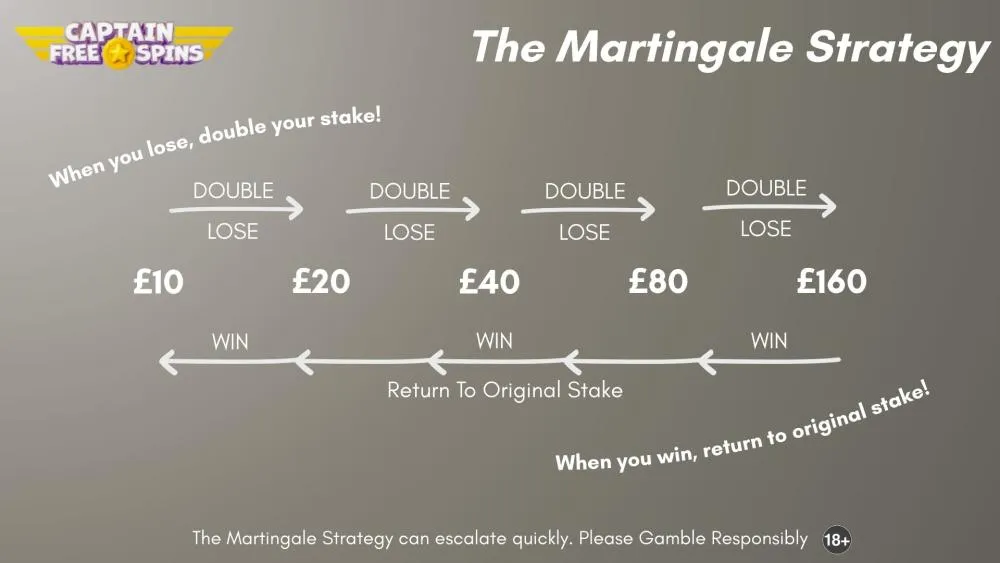
The Martingale is the most recognised roulette strategy, widely used by many players. It is most commonly used on even-money bets, such as red/black, odd/even, or high/low. It works by starting with a base stake, for this example we will use a £10 stake. If your bet loses, you double it, and you continue to do this until you win.
| Bet Number | Stake | Result | Total Profit/Loss |
|---|---|---|---|
| 1 | £10 | Loss | -£10 |
| 2 | £20 | Loss | -£30 |
| 3 | £40 | Loss | -£70 |
| 4 | £80 | Loss | -£150 |
| 5 | £160 | Win | £10 |
When the £160 bet wins at 1 to 1 payout, you receive £160 profit, plus your stake back, for a total return of £320. This will leave you with a net profit of £10, equal to your original stake. This is because across the five bets, £310 was staked (£10+£20+£40+£80+£160). The win then returns £320, resulting in a net profit of £10. You then return to your original stake and start the sequence again.
2 – The Reverse Martingale (Paroli)
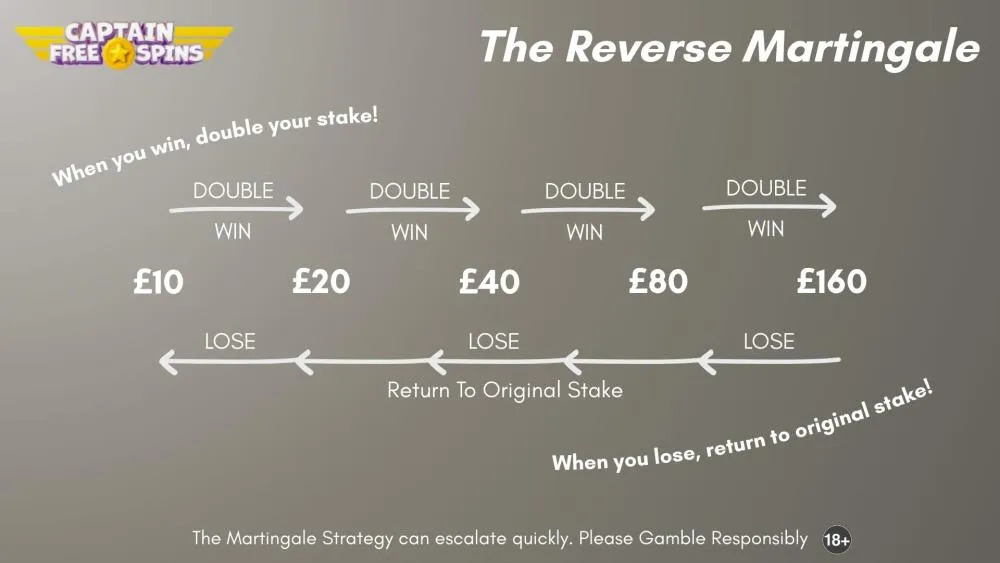
The Reverse Martingale, also known as the Paroli system, takes the opposite approach to the traditional Martingale strategy. Instead of doubling your stake after every loss, you double after every win. This is also used traditionally on even-money bets, such as red/black, odd/even, or high/low. Start with a base stake, for example, £10. Each time your bet wins, double the stake. When your bet loses, you revert back to the initial stake amount of £10. Below is an example of the Reverse Martingale and potential outcomes early on.
| Bet Number | Stake | Result | Total Profit/Loss |
|---|---|---|---|
| 1 | £10 | Win | +£10 |
| 2 | £20 | Win | +£30 |
| 3 | £40 | Loss | -£10 |
| 4 | £10 | Loss | -£20 |
| 5 | £10 | Win | -£10 |
After the five bets shown, with the three wins and two losses, the player would be at a net loss of £10. This system attempts to maximise profits with short winning streaks, and a single loss after increasing your stake can quickly remove any previous gains from earlier rounds.
3 – The Fibonacci Strategy
The Fibonacci strategy is based on the famous Fibonacci sequence, where each number is the sum of the two previous numbers. The sequence begins with 1, 1, 2, 3, 5, 8, 13, 21, 34, 55 and so on. Similar to the previous strategies, the Fibonacci strategy is usually applied to even-money bets such as red/black, odd/even, or high/low.
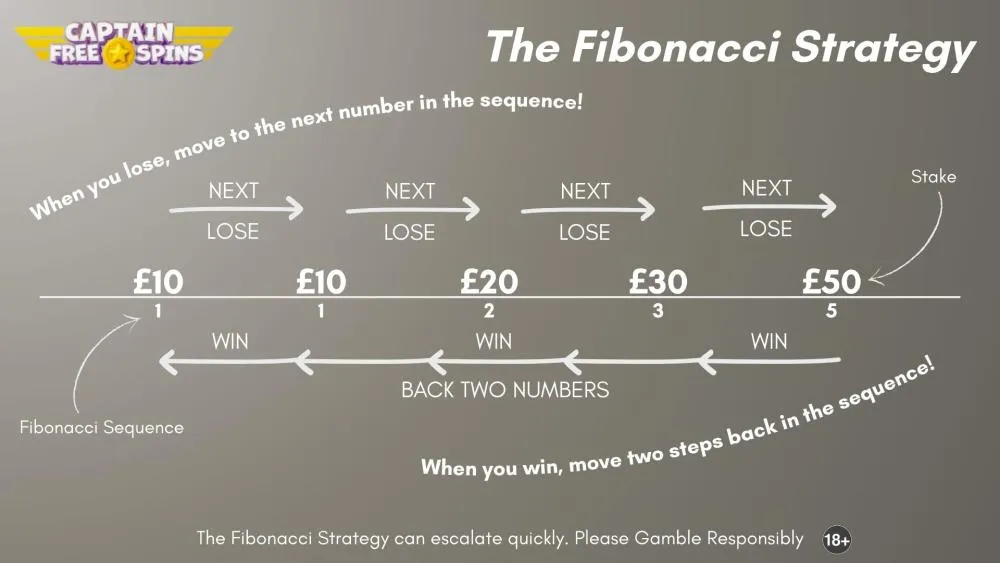
It works by betting based on the numbers in the sequence, for example, the sequence starts with 1, so our stake might be £10. When the sequence reaches number 5, the stake will be £50 (if using £10 as the base unit). If your bet loses, you move one step forward in the sequence. If it wins, you move two steps back. If you reach the beginning of the sequence, you restart the process from the first number in the sequence.
Unlike the Martingale system, the Fibonacci progression is much more gradual, which makes it feel less aggressive to the player.
| Sequence Position | Stake | Result | Total Profit/Loss |
|---|---|---|---|
| 1 | £10 | Loss | -£10 |
| 1 | £10 | Loss | -£20 |
| 2 | £20 | Loss | -£40 |
| 3 | £30 | Win | -£10 |
| 1 | £10 | Win | £0 |
In the example above, the first two losses move through the first two "1" positions. The third loss then moves onto the "2", which comes next in the sequence. The fourth bet moves to the "3", which wins. This means you move two steps back in the sequence, back to the "1". The next win moves it back again, back to the start. In this example, after the five bets, the net return is £0. It is important to remember this strategy does not change the house edge, which remains at 2.70% on a standard European wheel.
4 – The D'Alembert Strategy
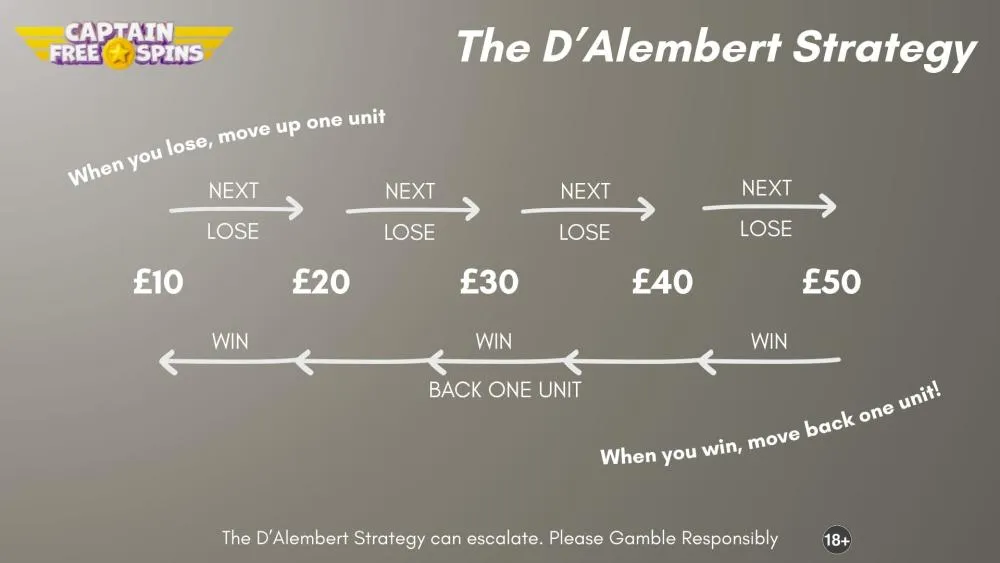
The D'Alembert strategy is more conservative compared to other strategies like the Fibonacci or Martingale. Rather than doubling stakes, it increases bets in small, steady increments. You start with a base stake, for example, £10. Rather than doubling with each loss, you increase by 1 unit, £10. If your bet loses, you would increase the next stake by £10. If your bet wins, you decrease by £10 until you return to the base stake. It is also most commonly used on even-money bets, such as red/black, odd/even, or high/low.
| Bet Number | Stake | Result | Total Profit/Loss |
|---|---|---|---|
| 1 | £10 | Loss | -£10 |
| 2 | £20 | Loss | -£30 |
| 3 | £30 | Win | -£10 |
| 4 | £20 | Win | £10 |
| 5 | £10 | Loss | £0 |
After the first loss, the stake increases by 1 unit, from £10 to £20. The second loss increases it another unit, to £30. A win would then bring the stake back down to £20, followed by another win to bringing it down to £10, the base stake. While this strategy feels less aggressive, it still doesn't change the house edge over the player.
Which Roulette Strategy is Best?
There is no single "best" strategy when it comes to roulette, as the house will always hold the 2.70% edge over the player. Strategies change both the risk level and volatility, but they do not change probability. Here's how the main systems mentioned above compare
| Strategy | Risk | Stake Growth | Best For |
|---|---|---|---|
| Martingale | Very High | Exponential | Small, Consistent Wins |
| Reverse Martingale | Moderate | Exponential | Short Win Streaks |
| Fibonacci | Moderate | Gradual | Slower Loss Recovery |
| D'Alembert | Lower | Linear | Controlled Increases |
The Martingale strategy recovers losses quickly, however it does come with the highest risk of large losses if you end up on a long losing streak.
The Reverse Martingale avoids chasing losses, but profits can be quickly lost with a single loss. It is reliant on short winning streaks to generate profit.
The Fibonacci strategy increases more gradually, but similar to Martingale, losing streaks can push stakes higher and lead to large losses.
D'Alembert grows much slower and more controlled, giving the feeling of a less aggressive increase. However the odds do not change and the house will still maintain the 2.70% edge.
Roulette Variants Explained
The main difference between the two roulette types revolves around the house edge.
European roulette wheels have 37 numbers, the single 0 being the edge. The 0 is what gives the house edge over the player. All payouts are calculated as if there were only 36 numbers, but there are 37. That extra number is 0. This gives the house a 2.70% edge over the player, meaning the average return to player (RTP) is 97.30%.
American roulette wheels contain 38 numbers, the extra being 00. This almost doubles the house edge from 2.70% to 5.26%. For better returns, European roulette has the advantage, with a higher average return-to-player. Some casinos even offer a triple-zero wheel, with a 7.69% edge to the house. At Captain Free Spins, we recommend you avoid these as much as possible.
There are also French roulette tables, although much rarer in the UK. These come with 2 special rules, explained below. Everything else remains the same, with the 37 numbers.
La Partage
La Partage, which translates to ‘The Divide’, is a unique rule found in French roulette tables. If the ball lands in the single 0, the house will return half of your original stake. For example, a £1 bet on red will return £0.50 back to you, rather than losing it all.
This rule only applies to even-money bets, red/black, odd/even, or high/low.
En Prison
Translating to ‘In Prison’, this rule keeps your bet active for another spin, if the ball lands in the 0, rather than losing it.
For example, if the player has a £1 bet on red, and the green 0 wins, the bet is left untouched and locked in for the next spin. If the next spin then lands on red, you get your full stake back (but no additional winnings). If it loses, your bet is forfeited as normal. Another green 0 means your bet will stay locked in for another spin, however this varies by casino.
This rule only applies to even-money bets, red/black, odd/even, or high/low.
| Roulette Type | Numbers | House Edge | RTP |
|---|---|---|---|
| European | 37 | 2.70% | 97.30% |
| American | 38 | 5.26% | 94.74% |
| French (La Partage) | 37 | 1.35% | 98.65% |
Both of the above rules provide increased odds to the player. The house edge is reduced from 2.70% to 1.35%. Although both provide the same RTP, the main difference between the two is psychological. As a player, with En Prison, you have the chance to win back your stake, rather than automatically losing half with La Partage.
Roulette FAQs
Is Roulette Completely Random?
Yes. Each spin of a roulette wheel is independent and random. Previous results have no influence on future spins. For example, if the previous five spins were red, this does not change the probability of the next spin landing on red, black, or green.
In online roulette, results are generated either by a physical wheel (live dealer games) or by a certified Random Number Generator (RNG). Both systems are designed and regulated to ensure fairness.
What Is The House Edge In Roulette?
The house edge depends on the type of roulette you play:
- European roulette (most common in the UK) has a 2.70% house edge due to the single green zero (0).
- American roulette has a higher house edge of 5.26% because of the additional green double zero (00).
- French roulette can reduce the house edge to 1.35% on even-money bets when La Partage or En Prison rules apply.
Some casinos also offer triple zero (000) roulette, increasing the house edge to 7.69%, which provides significantly lower long-term value.
What Is The Best Roulette Strategy?
There is no single strategy that can remove the house edge or guarantee profit. Systems such as Martingale, Fibonacci, and D’Alembert only change how you adjust your stakes. They influence risk and volatility but do not alter probability. The most effective way to improve long-term value is to choose the right variant. European and French roulette offer better mathematical returns than American roulette.
What Is The Safest Bet In Roulette?
Even-money bets — red/black, odd/even, and high/low — offer the highest probability of winning on each spin. On a European wheel, these bets have a 48.65% chance of success. However, all bets carry the same house edge. “Safer” simply means lower volatility and more frequent small wins, not better overall odds.
Can You Beat Roulette Long Term?
No. Roulette has a built-in house edge, meaning the expected return is negative over time. For example, on a European wheel with a 2.70% house edge, the casino expects to retain approximately £27 for every £1,000 wagered over the long term. Short-term wins are possible due to variance, but extended play favours the casino.
What Is Volatility In Roulette?
Volatility refers to how quickly your bankroll can rise or fall.
- Inside bets and aggressive betting systems create higher volatility, they win less frequently but pay larger amounts.
- Outside and even-money bets create lower volatility as they win more often but pay smaller returns. Volatility affects risk and bankroll swings, but it does not change the house edge.
Roulette is a game of chance, and as mentioned throughout, the RTP for European roulette is 97.30%, with the house edge sitting at 2.70%. If you do choose to play, always set limits, play within your means, and treat roulette as entertainment, not a source of income. For support on responsible gambling, click here .